At the Threshold of the Sorbonne: My First Semester as a Translation Master's Student

- March 2025, Julien Bonnaire
After completing my bachelor's degree in English and German between France and Germany, I wanted to take on a new challenge. That's why I decided to pursue a master's degree at the Sorbonne in Paris, this renowned place where so many great minds have studied.
This master's programme in translation is an exceptional course of study at the intersection of literary translation and specialised translation, which emerged from a collaboration between Sorbonne University and Heidelberg University in Germany as part of the 4EU+ alliance. This alliance comprises eight renowned institutions across Europe: Charles University in Prague, Heidelberg University, Paris-Panthéon-Assas University, Sorbonne University, Copenhagen University, Geneva University, Milan University and Warsaw University.
This programme offers academic study abroad in two countries: I completed the first semester of my first master's year in Paris at the Sorbonne and will spend the second semester at the University of Heidelberg at the Institute for Translation and Interpreting.

During my semester in Paris, I was able to fully immerse myself in the life of the capital and discover the significant places that make the Sorbonne a historic and prestigious institution. Founded in the 13th century by Robert de Sorbon, chaplain to King Louis IX, the Sorbonne is one of the oldest and most renowned universities in Europe. Originally a theological college for poor students, it was quickly integrated into the University of Paris, which became a bastion of medieval knowledge. Over the centuries, its vaulted halls have seen cardinals, philosophers and writers. Its time-worn stones carry the whispers of the great theological controversies of the Middle Ages, the spirit of the Enlightenment and the boldness of modern minds. Today, it remains a symbol of French intellectual excellence and welcomes researchers and students from all over the world.

I studied on the Malesherbes campus in the 17th arrondissement, but I also had the opportunity to visit the historic halls of the Sorbonne, where the names of those who studied there, from Victor Hugo to Paul Valéry, still resonate.
Academically, this semester was particularly rich and stimulating. I had the privilege of attending classes given by renowned figures from the world of translation: the official translator of Thomas Mann, who has won numerous awards for her French translation of The Magic Mountain; a professor who specialises in Kafka and has translated several of his books; a professor and translator who works for the French Ministry of Culture; and a Germanist who graduated from the ENS (École normale supérieure de Paris). Each of these encounters helped me to better understand the challenges, subtleties and creativity that characterise the art of translation and linguistics in general.
The courses covered a wide range of topics: translation studies, literary translation, linguistics, academic writing, translation and language history, English, Middle High German and much more. This diversity enabled me not only to acquire a sound knowledge of translation studies and literature, but also to develop a historical awareness of the subject area. I studied the history of translation from the Rosetta Stone to the patron saint of translators, Jerome of Stridon, through Martin Luther, Schleiermacher and Novalis.
Furthermore, comparative literature introduced me to the subtle mechanisms of cultural transposition, while linguistics courses gave me an understanding of the development and structure of languages and their classification into different language families. Finally, an introduction to research prepared me for writing my future master's thesis, which I will begin in my second year.
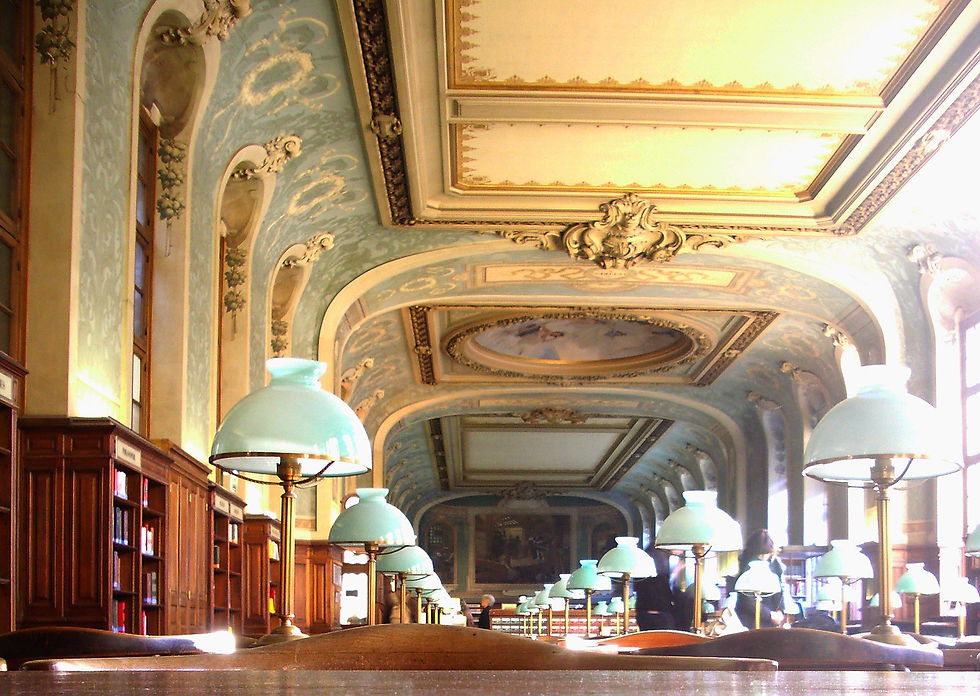
At the same time, this semester was marked by numerous cultural events in Paris: meetings with an Austrian writer at the Austrian Cultural Centre, a translation workshop on Kafka's works at the Goethe Institute, and visits to major Parisian libraries such as the Bibliothèque Inter-Universitaire de la Sorbonne, the Bibliothèque Sainte-Geneviève and the Bibliothèque nationale de France.
As part of translation workshops, we also translated a novel by Austrian author Laura Freudenthaler, Arson, whom we had the pleasure of meeting in person.
This first semester has reinforced my belief that translation is much more than just transferring words from one language to another: it is an art of nuance and cultural mediation, a bridge between cultures.

Now that I have completed my first semester at the Sorbonne, I am preparing to embark on the second part of this academic adventure at Heidelberg University, Germany's oldest university, where I will be able to deepen my skills in a German-speaking environment of the highest quality and further expand my international experience.


Commentaires